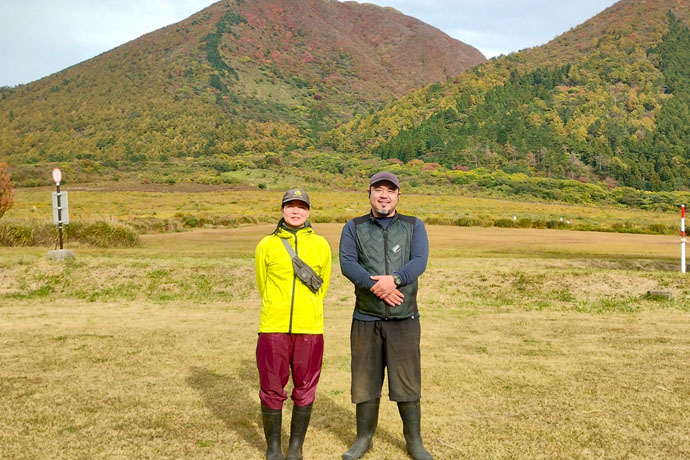
Kawamura Ranch
Total Area: Approx. 110 ha (Pasture: approx. 64 ha (32 + 32 ha))
Altitude: Approx. 450 m
Number of Grazing Cattle: Around 260 Japanese Black cattle, consisting of approx. 60 breeding cows, 95 brood cows, and additional heifers, calves, and fattening cattle
Number of Staff: 2–3 people
Terrain Features: Two grazing areas located along the mid-slope of Mt. Sanbe
— When grazing beef cattle, do you find any differences compared to dairy cattle?
There may be differences between Holsteins and Japanese Black cattle, but dairy cows seem to be better at eating grass because their noses differ. Dairy cows feel faster overall. Their walking style isn’t that different. For dairy cows, since you milk them every day, managing water sources becomes very important. For Japanese Black cattle, depending on the season, the dew in the morning and at night is enough for them, so sometimes they don’t even come to the watering point.
— How often do cattle break out of the pasture?
This year, we haven’t had any major cases. Sometimes one or two cattle step out a little and we bring them back. Previously, when we had a cow that escaped the pasture, we noticed through its location data that it kept approaching the fence around noon. Thanks to “Ushimilu,” we were able to bring it back in. There was also one case where it wasn’t actually an escape, but all cattle in Pasture 1 were shown in Pasture 2 on Ushimilu. When we checked, they had followed along the fence line and ended up entering Pasture 1.
— Why did you choose “Ushimilu” as a grazing monitoring tool?
It was introduced to us as part of a smart-agriculture initiative, so we applied for it. A long time ago, we tried attaching pagers to cattle so they would come when the pager beeped, but some never responded. Because of battery life and communication range issues, it didn’t work well in the end.
— Have your daily tasks changed since introducing “Ushimilu”?
Since the cattle don’t always return to the barn each day, it has become much easier to locate them during feeding. Before, we would call them from the mountains and they wouldn’t show up, so sometimes we had to return without feeding them. Sometimes when I went to call them—because they hadn’t come—they were actually already heading toward us, leaving us thinking, “Ah, that’s not what I needed right now…” Just going back and forth takes 20–30 minutes, so if that happens twice a day, you lose about an hour. Now we check on Ushimilu that the cattle have come down the mountain before going out to feed them. At night, we used to have no idea where they were, so we’d shout into the darkness while feeding them. Now there’s no need for that. Being able to see them is truly amazing.
— Has your response to accidents or unexpected events changed?
We’ve discovered behavioral patterns we didn’t know before, and that accumulated knowledge helps us respond more quickly to irregular situations. In the past, if we needed to look for cattle involved in an accident or trouble, it took around 10 days, because we could only search in between our daily tasks. When a cow gave birth and didn’t come to the feeding area for several days, we could now check the feeding area on Ushimilu, which gave us peace of mind. Around twenty cattle have been found thanks to GPS. Before introducing the system, when cattle went missing, we almost never found them alive. But now we can find them normally. Even when we managed to find them before, they were usually already dead. But last year, for the first time, we were able to bring one alive to the slaughterhouse. Until now, we would only realize something was wrong when crows swarmed around a dead cow.
— Have you learned or noticed anything from having access to cattle movement history?
It’s interesting to see the cattle’s movement patterns throughout the day on Ushimilu. When a cow stays resting for a long time at a certain spot, we sometimes go check what kind of place it is. Being able to discover their favorite spots is thanks to GPS.
— Have you seen effects that match the cost?
If you ask me directly… that’s a tough question. Assuming the Ushimilu collars continue to function properly going forward, I would definitely want at least five collars per herd. Most likely, we would want more and more as we go. Originally, we lost four cattle per year. If Ushimilu helps us find two of them alive, then depending on the insurance payout, we could recoup the cost in a few years. For small-scale farms, cost recovery can be difficult, but for farms of a certain size, it is absolutely worthwhile.
※ Note from the Provider We sincerely apologize for the issues that occurred with some solar panels and Ushimilu collars during initial deployment. The system is currently operating normally, but we will continue working to resolve the remaining issues. Thank you very much for your honest feedback.
Link destination
