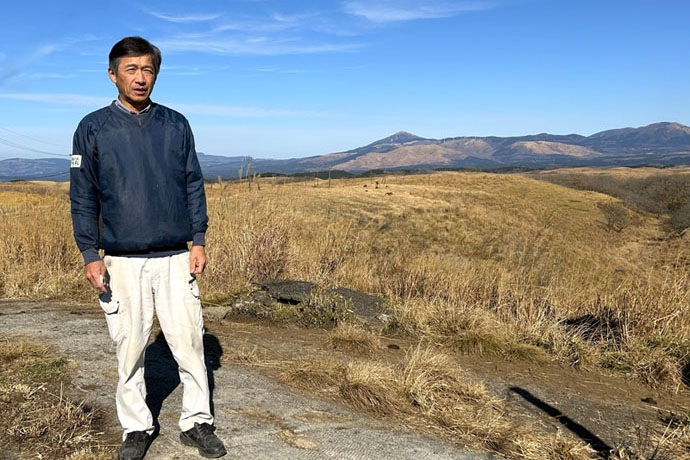
Yamada Seibu Pasture Cooperative Association
Pasture area: 261 ha
Altitude: 858 m
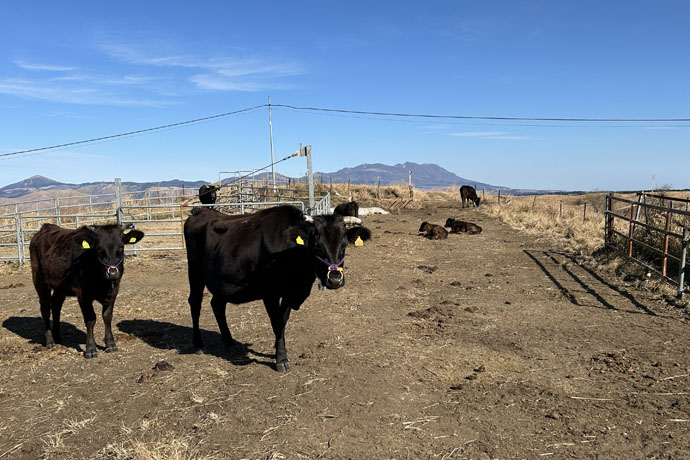
Number of grazing cattle: Approx. 70 (Japanese Black cattle, Japanese Brown cattle)
Number of gateways installed: 1
Number of collars introduced: 10
Number of staff managing grazing: 5 (one person per day on rotation)
Grazing operation period: Apr 10–Nov 30 (Extended grazing from Dec 1–Apr 9)
— Considering the climate and terrain of the Aso region, could you tell us about the characteristics of your pasture and any ways you manage grazing?
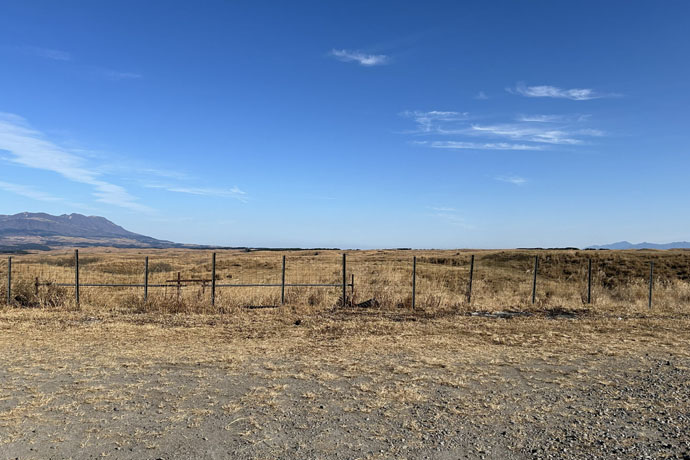
One of the best things about our pasture is that we divide it into five grazing sections, and basically there is running water in all sections throughout the year. That said, in recent years the water sometimes dries up depending on the season. When that happens, we open other sections and adjust our operation accordingly.
— How do you manage the cattle while they are grazing?
In the morning, we check the headcount. In the afternoon, we patrol again to confirm cattle that we didn’t spot in the morning, as well as cows that are in estrus. We also check on calving, since cows often go to places that are out of sight when they give birth.
— How often do troubles occur?
Occasionally, cattle fall due to an accident and go missing. Sometimes they also wander into neighboring grazing sections. But after a few days, they somehow return before we know it.
— What made you decide to introduce Ushimiru?
Last year, we attended a training session and heard a performance report on Ushimiru from the regional promotion bureau. I found it interesting and decided to introduce it.
— When introducing the collars, were you concerned about behavioral changes or stress in the cattle?
Yes, we were. The collars were bigger than I expected.*1 However, once we actually put them on, it didn’t feel as disruptive as I had imagined. I do think we need to tighten the belt so it won’t get caught on things like stakes.
— In what situations do you typically use Ushimiru?
When we are looking for cattle that we can’t find, we check Ushimiru in a place where we have mobile reception, confirm “They’re over there,” and then focus our search in that area.
— What changes have you seen in patrols and confirmation work?
If a collared animal is communicating, we can find it quickly and understand its approximate location. However, sometimes the “last received time” is the previous day or even two days earlier. In that case, we review routes we hadn’t checked. At our pasture, we put collars only on younger cattle and cows that are close to calving. The other cattle generally move together with the collared animals.
— After introducing Ushimiru, did your work change or become more efficient?
(Many members) bring two young cattle together when they start grazing, so if we put a collar on one of them, we can usually assume the other is nearby as well. Cows in estrus also need to be moved into the paddock before the insemination technician arrives. Even when fog is so thick that we can’t see anything, we can find them faster by using Ushimiru. In the past, we searched for missing cattle blindly. Since introducing Ushimiru, we’ve been able to narrow down the approximate location and search more efficiently, which has made the work easier.
— Did you get used to operating Ushimiru and fitting the collars quickly?
We understand that features like movement history can be used, but because mobile reception isn’t as stable as we’d like, we end up using only the minimum functions.*2 Putting on the collars is easy once you catch the cattle. Since we have a handling frame, we can catch them if they enter it, and if we feed them and get them used to people, they’ll come over to us. If I had to ask for one thing, I’d like the collar to be a little thinner.*1
— Do you have an episode where you felt “This really helped” or “This is convenient”?
When cows calve, they usually give birth in places out of sight. Even if they’re normally in visible areas, when it comes time to calve, they often go to locations that are very hard to find no matter how much you search. That’s why we put Ushimiru on higher-risk cattle, such as pregnant cows. In those cases, Ushimiru shows us the approximate location, which helps us find them. At first, we were searching in a different area. Then, in a spot with mobile reception, we checked the previous day’s movement history. When we went there in the afternoon, the cow recognized my vehicle and came out with her calf.
— Are there any improvements or additional features you would like to see in Ushimiru going forward?
Above all, more reliable reception. It would really help if communication worked everywhere on the pasture.*3
— Do you feel you have gotten benefits that match the cost?
For example, if a calf got caught and couldn’t move, and Ushimiru helped us find it and treat it—even if it were just one animal—I think you could say it would have paid for itself. So far, none of the collared cattle have been in that kind of dangerous situation. But if we were able to say “It was saved because it had the collar on,” I think the value would be well worth the cost.
— Are there any hurdles or practical challenges you feel about introducing Ushimiru?
Even if we want to adopt it, it costs money. If even one person in the cooperative objects, I think it would be difficult to cover it as a cooperative expense. However, as the core members shift to younger people and we become able to use Ushimiru effectively, I think the conversation will change to, “Wouldn’t it be better to have this?”
*1 In addition to “Ushimiru Collar Model 1,” a thinner and lighter “Ushimiru Collar Model 2” is also available for purchase.
*2 To use Ushimiru, both the gateway and the smartphone used for viewing must be connected to a network.
*3 Depending on the pasture size and terrain, installing multiple gateways can create a more stable communication environment.
Link destination
