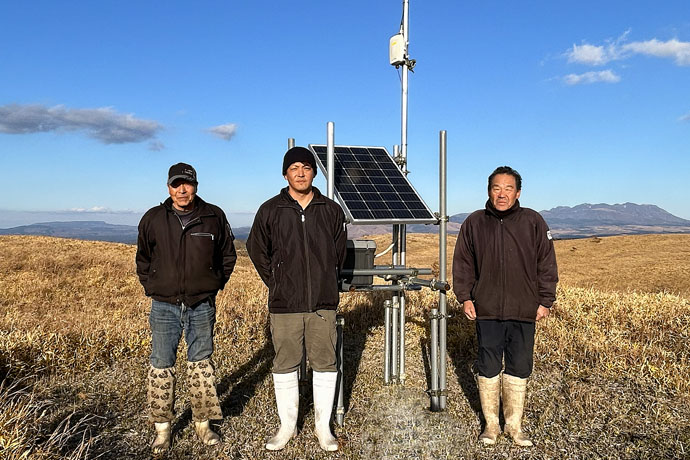
Agricultural Cooperative Association Yunoura Ranch
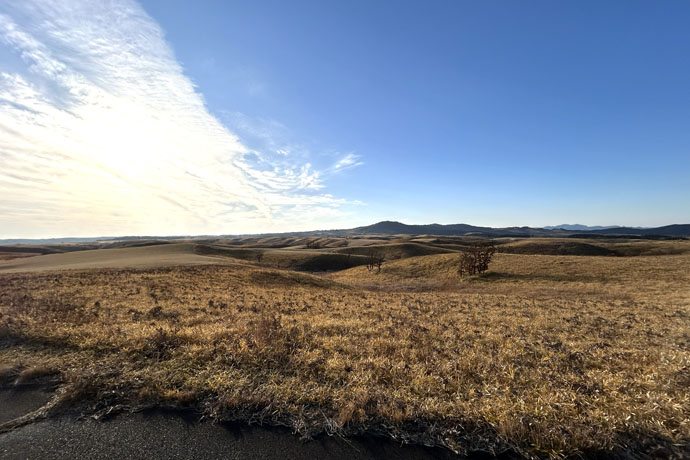
Pasture area: 443 ha
Altitude: 878 m
Number of grazing cattle: 40 (Japanese Black cattle)
Number of gateways installed: 1
Number of collars introduced: 25
Number of staff managing grazing: 5 (one person checks once every two days)
Terrain characteristics: Mostly flat with little slope, but with deep valleys
Grazing operation period: Year-round grazing
— Are there any difficulties in managing grazing cattle due to the climate and terrain unique to the Aso region?
This pasture is fairly flat and the slopes aren’t very steep, but it’s quite large and the valleys are deep. Because we use spring water, the cattle’s whereabouts are generally predictable. But when they occasionally move away from their usual spots, it becomes difficult to monitor them. Sometimes we realize, “We haven’t seen that animal for a few days,” and accidents can happen.
— Before, how did you manage the cattle while they were grazing?
A staff member would go out once every two days in the morning. For cows close to estrus or calving, we would check them separately as needed.
— How do you feel about Ushimiru’s communication environment on the pasture?
Overall, it works across the pasture, but sometimes there can be gaps of one hour*1 or even two hours. But during the day the cattle are eating grass and lying down—they’re not moving constantly—so it doesn’t bother us that much.
— How often do troubles occur?
Fence breakouts happen occasionally. The number of grazing cattle and even the number of livestock farmers has been decreasing year by year, and maintaining a pasture of this size makes it difficult to keep up with repairs to gates, fences, and related facilities.
— What made you decide to introduce Ushimiru?
It was introduced to us by the local government office, and there was also a subsidy program, so we decided to give it a try. Patrol monitoring usually took three to four hours. Before introducing Ushimiru, when we couldn’t find an animal, we would keep searching and even four hours wasn’t enough. We wanted to at least know roughly where the cattle were by checking a map.
— When introducing the collars, were you concerned about behavioral changes or stress in the cattle?
Yes, we were concerned about the size at first.*2 But after actually putting them on, there was no problem. We haven’t had issues with collars coming off, getting caught, or the belt fraying. Yes, we were concerned about the size at first.*2 But after actually putting them on, there was no problem. We haven’t had issues with collars coming off, getting caught, or the belt fraying.
— In what situations do you typically use Ushimiru?
Based on experience, we have a general sense of where the cattle are, but we use Ushimiru to confirm. Before going on a patrol, we check it to grasp roughly where they are.
— After introducing Ushimiru, did your work change or become more efficient?
The biggest change is that monitoring time became shorter. Instead of going around and thinking, “They’re not here,” we can go out with a rough idea of where to look. Now we can check Ushimiru at home before heading out and confirm the cattle’s locations in advance, which has improved the efficiency of our confirmation work.
— Did you get used to operating Ushimiru and fitting the collars quickly?
Location information. We have another grazing area that’s separate and quite far away. We also put collars on some cattle there, and even on days when I’m not in charge, I can confirm they’re there without having to go all the way to the site.
— Do you have an episode where you felt “This really helped” or “This is convenient”?
When someone else was monitoring, they called me and said, “It looks like there may have been a miscarriage.” I headed to the pasture in the afternoon, but I couldn’t find the exact spot. However, Ushimiru lets you see the stop time in the activity history. I checked that, estimated the area, went there, and was able to find the cow.
— Do you feel Ushimiru is easy to use even on farms with different terrain conditions?
I don’t think there are many farms with ideal conditions where flat land just continues. But since our pasture is quite large and includes steep slopes, and Ushimiru still picks up the data properly, we don’t have any problems.
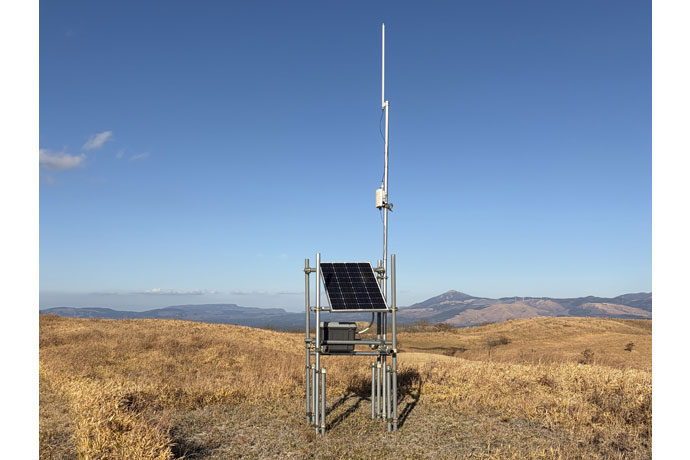
*1 When the accelerometer built into the Ushimiru collar detects that the animal is stationary, the transmission interval automatically changes from 20 minutes to 1 hour.
*2 In addition to “Ushimiru Collar Model 1,” a thinner and lighter “Ushimiru Collar Model 2” is also available for purchase.
Link destination
